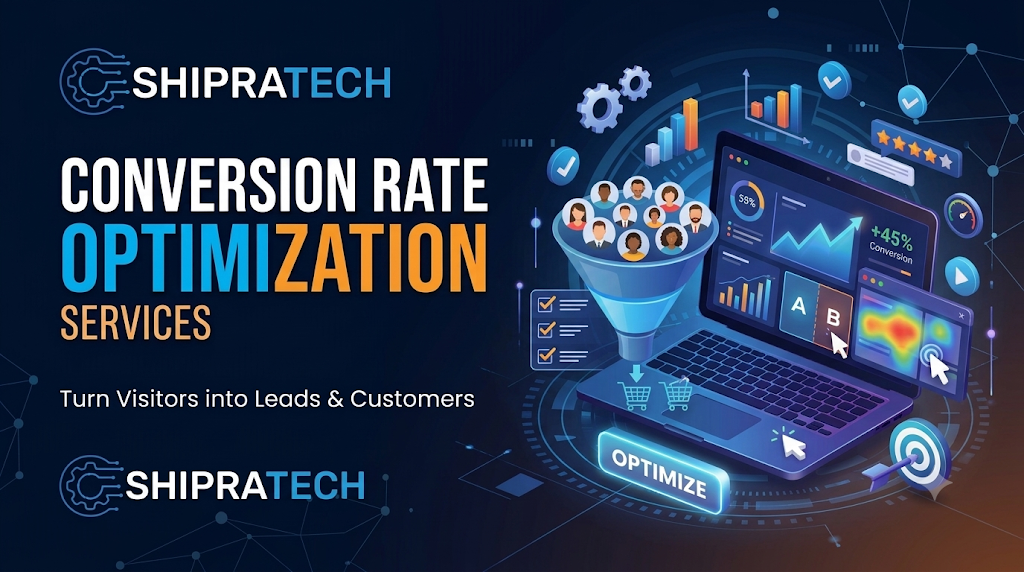
You have invested in your website. You are paying for SEO, running Google Ads or posting on social media to bring people in. Yet when you check the numbers, only a small fraction of visitors actually call, fill in a form or buy. The rest arrive, look around and leave.
That gap between traffic and results is exactly what conversion rate optimization services are designed to close. Instead of spending more to attract more visitors, CRO focuses on getting more value from the visitors you already have.
In this complete guide, we cover what CRO is, why it matters, what a professional service includes, how landing pages fit in, what small businesses can do, and how to choose between an agency, a consultant and a company.
What Are Conversion Rate Optimization Services?
Conversion rate optimization (CRO) is the practice of improving your website and landing pages so that a higher percentage of visitors take a desired action. That action, called a conversion, could be:
- Submitting a contact or enquiry form
- Calling your business directly
- Booking a demo, appointment or consultation
- Adding a product to the cart and completing checkout
- Subscribing to a newsletter or starting a free trial
- Downloading a brochure, guide or price list
Your conversion rate is the number of visitors who complete the action divided by your total visitors. If 2,000 people visit a page and 40 submit an enquiry, your conversion rate is 2 percent.
CRO services use data, user behaviour and structured testing to raise that number steadily. It is not about tricks or gimmicks. It is about understanding why people hesitate and removing those barriers.
Why Conversion Rate Optimization Matters
Most businesses obsess over traffic. But traffic alone does not pay the bills. Consider two businesses that both get 5,000 visitors a month. The one with the better-converting website earns more leads or sales from exactly the same traffic and the same ad budget.
Here is why CRO deserves a place in your marketing plan:
- It lowers your cost per lead. When more visitors convert, each lead costs you less to acquire.
- It makes ad spend work harder. Paid clicks are expensive. Better landing pages turn more of those clicks into customers.
- It reveals what customers really want. Behaviour data shows what people respond to, which also improves your messaging and offers.
- It compounds over time. Every successful improvement keeps delivering month after month.
- It reduces dependence on traffic. You can grow without constantly raising your marketing budget.
What Do Website Conversion Optimization Services Include?
Professional website conversion optimization services follow a structured process rather than relying on opinions or guesswork. Here is what a thorough engagement typically covers.
1. Analytics and Tracking Setup
Before anything is changed, a good CRO team makes sure your tracking is accurate. That means setting up goals, events, form submissions, phone call tracking and, for online stores, purchase tracking. Without clean data, you cannot tell what is working and what is not.
2. Funnel and Behaviour Analysis
Next comes understanding how visitors move through your site. The team looks at where people arrive, which pages they visit, where they click, how far they scroll and where they leave. Tools such as heatmaps, session recordings and funnel reports expose friction points that are invisible from the outside.
3. Conversion Audit
A full review of your key pages looks at headlines, calls to action, forms, navigation, trust signals, page speed and the mobile experience. The goal is to identify what is stopping visitors from acting.
4. Research and Customer Insight
Strong CRO also listens to real customers. Surveys, feedback, sales call notes and support questions often reveal doubts and objections that your pages fail to address.
5. Hypotheses and Prioritisation
Findings are turned into specific, testable ideas, for example, “Shortening the form will increase enquiries.” Ideas are then ranked by expected impact and effort, so the highest-value changes come first.
6. A/B Testing and Implementation
Variations of your page are tested against the original so decisions rest on evidence. Winning changes are rolled out, and unsuccessful ones are dropped before they can hurt performance.
7. Reporting and Continuous Improvement
Results are tracked against your goals, learnings are documented, and the next round of improvements is planned. CRO is an ongoing cycle, not a one-time redesign.
Common Reasons Visitors Do Not Convert
Understanding what usually goes wrong helps you see where the opportunity lies. These are some of the most common conversion killers:
- Unclear value proposition. Visitors cannot quickly tell what you offer or why it is better.
- Weak or hidden calls to action. If people have to hunt for the next step, many will not.
- Long or complicated forms. Every extra field gives visitors another reason to quit.
- Slow page speed. People leave pages that take too long to load, especially on mobile.
- Poor mobile experience. A layout that works on desktop but frustrates on a phone loses a large share of visitors.
- Lack of trust. Missing reviews, testimonials, certifications or contact details make visitors hesitate.
- Confusing navigation. Too many options or unclear menus pull attention away from the goal.
- Mismatch between ad and page. If the landing page does not deliver what the ad promised, visitors bounce.
Landing Page Conversion Optimization
Landing pages are where much of your paid traffic arrives, which makes them one of the highest-impact places to optimise. Landing page conversion optimization focuses on making one page do one job really well.
Key elements include:
- A clear, benefit-led headline that matches the ad or search term the visitor came from
- One primary call to action rather than several competing options
- Short, simple forms that ask only for what you truly need
- Trust signals such as client logos, reviews, certifications and guarantees
- Supporting content that answers likely questions and objections
- Fast loading and mobile-friendly design, since many visitors arrive on phones
- Message match, so the page delivers exactly what the ad promised
Even modest changes to these elements can noticeably improve how many clicks turn into leads.
CRO Services for Small Businesses
Many people assume CRO is only for large e-commerce brands with huge traffic. That is a myth. CRO services for small businesses can be especially valuable because every lead counts and marketing budgets are limited.
For smaller sites with modest traffic, a good partner focuses on practical, high-impact fixes rather than complex testing programmes:
- Sharpening the headline and call to action on your most important pages
- Simplifying contact forms and adding click-to-call buttons for mobile visitors
- Placing testimonials and trust badges where visitors tend to hesitate
- Fixing slow pages and broken mobile layouts
- Making sure every enquiry and phone call is tracked properly
- Improving the clarity of your services and pricing information
These improvements often deliver strong returns without a large investment, and they set a solid foundation for more advanced testing as your traffic grows.
Website Conversion Rate Improvement: Where to Start
If you want to begin improving your own site, here is a simple order of attack that mirrors how professionals work:
- Confirm your tracking works. You cannot improve what you cannot measure.
- Find your most important pages. Focus on the pages with the most traffic or the most business value.
- Fix obvious problems first. Slow loading, broken forms and poor mobile layouts are quick wins.
- Clarify your message. Make sure a first-time visitor understands what you offer within seconds.
- Strengthen your calls to action. Make the next step obvious and easy.
- Add proof. Reviews, case results and guarantees reduce doubt.
- Test one change at a time. This way you learn what actually moved the numbers.
Agency, Consultant or Company: Which Is Right for You?
When you start looking for help, you will find several types of providers. Here is how they compare.
| Option | Best For | Things to Consider |
| Conversion rate optimization agency | Businesses wanting a full team covering analytics, design, development and testing | Broader skills and capacity, usually a higher cost |
| Conversion rate optimization consultant | Companies needing expert strategy, audits and a clear roadmap | Excellent for direction, but you may need to handle execution |
| Conversion optimization company | Businesses wanting a structured, repeatable service with defined reporting | Check for transparency and clear processes |
| In-house team | Larger organisations with steady traffic and resources | Requires hiring, tools and ongoing management |
For many small and mid-sized businesses, a website conversion optimization agency offers the best balance, because you get strategy and execution together without building a team from scratch. A conversion rate optimization consultant is a smart choice when you mainly need expert guidance and already have developers who can implement the changes.
How to Choose the Right CRO Partner
Before you commit to any provider, ask these questions:
- How do you start? A good partner begins with analytics and research, not a redesign pitch.
- How do you decide what to change? Look for data and testing, not personal opinions.
- What will you report on? You should see leads, sales and conversion rate, not just vanity metrics like page views.
- Can you work with my traffic level? Low-traffic sites need a different approach than high-traffic ones.
- Who will build the changes? Make sure someone can actually implement the recommendations.
- How do you handle tracking and privacy? Responsible handling of your data matters.
- Are your promises realistic? Be cautious of anyone who guarantees a specific percentage increase.
How to Measure CRO Success
Good CRO is measured by business results, not just prettier pages. Track metrics such as:
- Conversion rate for each key page and traffic source
- Cost per lead or cost per acquisition
- Number of qualified leads or sales
- Bounce rate and engagement on important pages
- Form completion rate and checkout completion rate
- Revenue or lead value per visitor
Compare results over meaningful time periods, and always tie improvements back to real business outcomes.
Signs Your Website Needs CRO
You may benefit from conversion optimization if:
- You get decent traffic but few enquiries or sales
- Your Google Ads cost per lead keeps rising
- Visitors leave quickly after landing on key pages
- Mobile visitors convert far less than desktop visitors
- Your forms or checkout have a high drop-off
- You have never tested your headlines or calls to action
- You are planning to increase ad spend and want it to work harder
FAQs
What are conversion rate optimization services?
They are services that improve your website and landing pages so more visitors become leads or customers, using analytics, user research and testing.
How much do CRO services cost?
Cost depends on the scope of work, your traffic and whether you need an audit, ongoing testing or full implementation. A good provider will scope your needs and give a clear quote.
How long does CRO take to show results?
Quick fixes to obvious problems can help fairly soon, while testing-based programmes build results over several weeks and months.
Is CRO worth it for a small business?
Yes. Getting more leads from the traffic you already have is often cheaper than buying more traffic.
What is a good conversion rate?
It varies widely by industry, traffic source and offer, so the best benchmark is your own past performance. The goal is steady improvement over time.
What is the difference between SEO and CRO?
SEO brings the right visitors to your site, while CRO makes sure those visitors take action. They work best together.
Do I need a lot of traffic for A/B testing?
Testing works best with higher traffic, but smaller sites can still gain from audits, usability fixes and best-practice improvements.
Should I hire a CRO agency or a consultant?
An agency suits businesses that want strategy and execution together. A consultant suits those who mainly need expert guidance and can implement changes themselves.
Can CRO help my Google Ads performance?
Yes. Improving your landing pages can raise conversion rates from paid clicks, which lowers your cost per lead without changing your ad budget.
Conclusion
Getting visitors to your website is only half the battle. The real payoff comes when those visitors become enquiries, bookings and sales. Conversion rate optimization services close that gap by finding what holds visitors back and fixing it with data instead of guesswork.
Whether you choose a conversion rate optimization agency, a consultant or a conversion optimization company, pick a partner who starts with analytics, tests before changing, and reports on results that matter to your business. Start with the basics, fix what is clearly broken, and keep improving step by step. Do that, and the traffic you already have can start doing far more for you.
Read the full guide on
Email: ansh@techbliss.in
Mobile: +91 9716813099
Website :- Shipratech