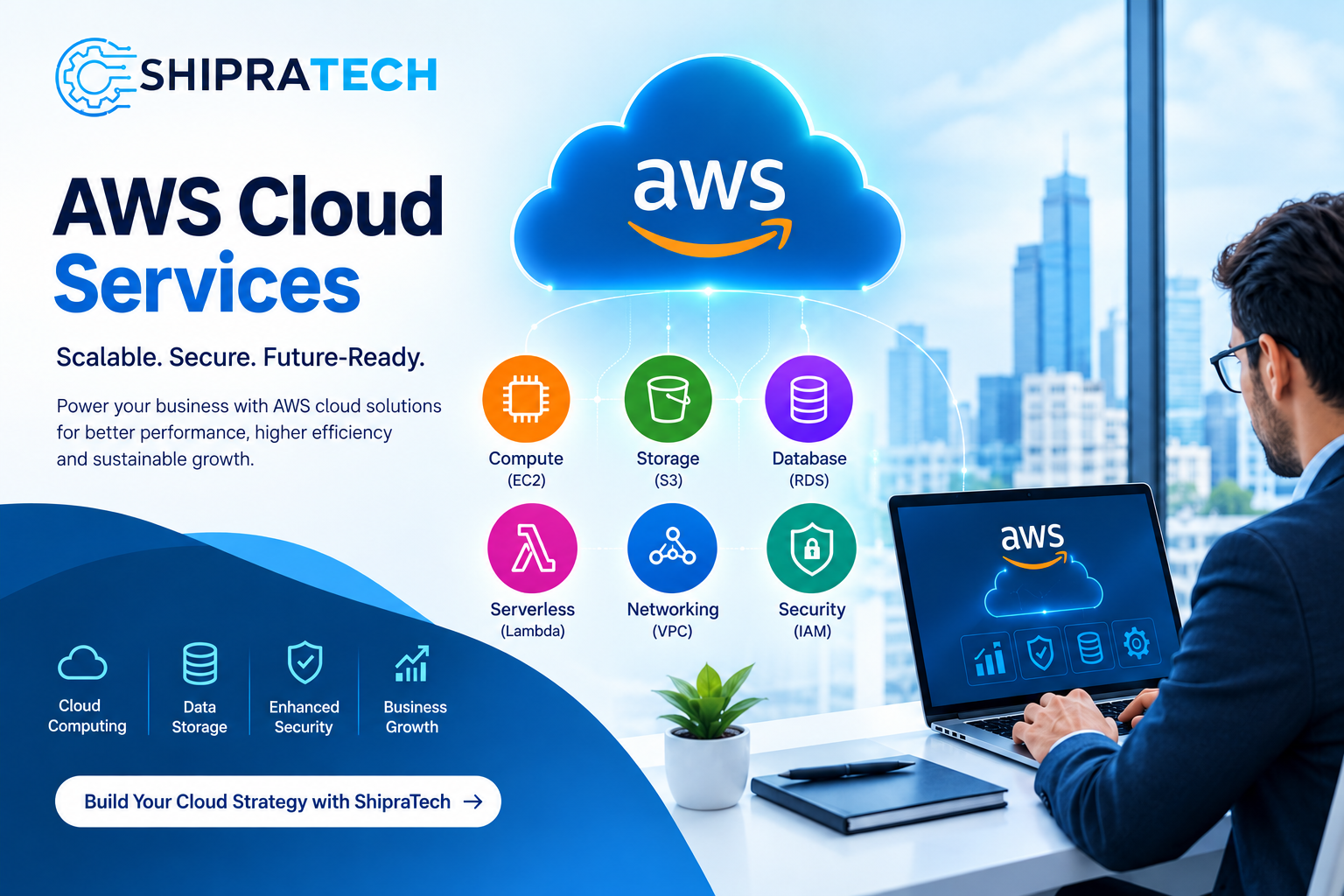
In today’s digital business environment, organizations need reliable, secure, and scalable technology to remain competitive. AWS Cloud Services help businesses host applications, store data, manage IT infrastructure, improve security, and scale operations without depending entirely on physical servers.
Amazon Web Services (AWS) offers a wide range of cloud computing solutions for startups, small businesses, and enterprises. With the right AWS cloud solutions, organizations can improve operational efficiency, support business growth, and adapt their technology infrastructure to changing requirements.
ShipraTech helps businesses explore cloud technology and evaluate AWS solutions according to their infrastructure, performance, security, and business needs. Whether you are planning to migrate existing applications or build a new cloud environment, choosing the right services is an important step towards successful cloud adoption.
What Are AWS Cloud Services?
AWS Cloud Services are technology solutions provided by Amazon Web Services over the internet. They include computing power, data storage, databases, networking, security, analytics, and application development tools.
Instead of purchasing and maintaining all their own physical servers, businesses can provision cloud resources according to their requirements. This approach offers greater flexibility and makes it easier to deploy applications, manage business information, and accommodate changing workloads.
Common uses of AWS cloud services include:
- Hosting business websites and web applications.
- Storing files, documents, images, and backups.
- Running enterprise applications and databases.
- Migrating workloads from on-premises infrastructure.
- Supporting software development and deployment.
- Improving monitoring, security, and disaster recovery.
- Building scalable digital products and online platforms.
Businesses can explore ShipraTech’s AWS Cloud Services to learn more about cloud solutions relevant to their technology requirements.
What Is AWS Cloud Computing?
AWS cloud computing is the delivery of computing resources, storage, databases, networking, and other IT capabilities through Amazon Web Services.
Traditional IT infrastructure often requires significant investment in hardware, maintenance, and upgrades. AWS cloud computing allows businesses to provision resources when required and adjust their infrastructure as workloads change.
For example, an e-commerce company can use Amazon EC2 to host its application, Amazon S3 to store product images, and a managed database to maintain customer and order information.
This flexible approach helps organizations develop, deploy, and operate applications without having to manage every physical component of the underlying infrastructure.
How Does AWS Cloud Computing Work?
AWS provides cloud infrastructure through a global network of Regions and Availability Zones. Businesses select suitable services, configure their resources, and manage them through the AWS Management Console, APIs, command-line tools, and automation.
A typical cloud environment may include:
- Computing resources for applications and websites.
- Storage services for files, backups, and digital assets.
- Databases for structured and application data.
- Networking services for connectivity and traffic management.
- Security controls for identity, permissions, and monitoring.
The specific architecture depends on application requirements, expected traffic, security needs, and budget.
Types of AWS Cloud Services
AWS provides services for a variety of business and technical requirements. Understanding the major categories helps organizations identify appropriate solutions.
1. AWS Computing Services
Computing services provide the processing resources required to run websites, applications, software, and business workloads.
Amazon EC2 offers virtual servers with configurable computing resources. AWS Lambda allows businesses to execute code in response to events without managing traditional servers.
These services are useful for application hosting, development environments, enterprise workloads, and automated business processes.
2. AWS Storage Services
AWS storage solutions help businesses store and retrieve digital information according to their performance, access, and retention requirements.
Amazon S3 provides scalable object storage for documents, images, backups, and application data. Amazon EBS provides block storage for use with Amazon EC2 instances.
Organizations can use suitable storage configurations to support data management, backup strategies, and business continuity.
3. AWS Database Services
Databases support websites, applications, customer platforms, inventory systems, and business operations.
Amazon RDS simplifies the management of supported relational databases, while Amazon DynamoDB provides a managed NoSQL database service.
The appropriate database depends on the application’s data structure, performance requirements, consistency needs, and scalability objectives.
4. AWS Networking Services
Networking services connect cloud resources and help businesses manage communication between applications, users, and systems.
Amazon VPC enables organizations to create logically isolated virtual networks. Other AWS networking services support domain name routing, content delivery, connectivity, and traffic distribution.
A well-designed network helps improve infrastructure organization, security, and application availability.
5. AWS Security Services
Security is an essential part of every cloud environment. AWS provides tools that help businesses manage access, record activity, and identify potential threats.
AWS Identity and Access Management (IAM) helps control permissions. AWS CloudTrail records account activity and API events, while Amazon GuardDuty helps detect certain suspicious activities and potential threats.
Businesses should combine these services with strong authentication, least-privilege permissions, encryption, monitoring, and appropriate security policies.
What Are the Top 5 AWS Services?
Five widely used AWS services are Amazon EC2, Amazon S3, Amazon RDS, AWS Lambda, and Amazon VPC. Their suitability depends on the business application and its technical requirements.
Amazon EC2
Amazon Elastic Compute Cloud (EC2) provides virtual servers for hosting applications, websites, and business systems. Businesses can select instance configurations according to computing, memory, and networking needs.
Amazon S3
Amazon Simple Storage Service (S3) provides object storage for files, media, backups, application assets, and data analytics workloads.
Amazon RDS
Amazon Relational Database Service (RDS) simplifies the deployment and management of supported relational databases, reducing routine administrative work.
AWS Lambda
AWS Lambda runs code in response to events without requiring users to manage traditional servers. It supports event-driven applications, automated workflows, and backend processing.
Amazon VPC
Amazon Virtual Private Cloud (VPC) enables organizations to create isolated virtual networks and configure routing, connectivity, and security controls.
Together, these services can form part of a cloud architecture for business applications, digital platforms, and enterprise workloads.
Benefits of AWS Cloud Solutions for Businesses
Scalability and Flexibility
Business workloads can change as an organization grows. AWS allows businesses to adjust resources according to demand, helping them accommodate increased traffic and evolving operational requirements.
Cost Optimization
AWS offers consumption-based pricing for many services, allowing businesses to pay for resources according to usage and selected pricing models. This can reduce the need for upfront hardware investment.
However, cloud infrastructure still requires budget management. Unused resources, data transfer, storage, and unsuitable configurations can increase costs. Monitoring usage and reviewing resource allocation can help businesses optimize expenditure.
Improved Business Continuity
Cloud-based backups and properly designed recovery strategies can help organizations protect data and restore operations after disruptions. Businesses should define recovery objectives, test backups, and document disaster recovery procedures.
Security and Access Management
AWS provides tools for managing permissions, encryption, monitoring, and threat detection. Effective security also depends on correct configuration and the shared responsibility model between AWS and the customer.
Faster Deployment
Cloud resources can often be provisioned more quickly than traditional physical infrastructure. This helps development teams build, test, and deploy applications while adjusting capacity to meet project requirements.
Global Infrastructure
AWS offers infrastructure across multiple geographic Regions and Availability Zones. Businesses can select deployment locations based on latency, resilience, regulatory obligations, and data residency requirements.
AWS Cloud Solutions for Different Business Requirements
AWS cloud solutions can support businesses at different stages of growth.
For startups: Launch websites, applications, and digital products without purchasing all the underlying physical infrastructure upfront.
For small and medium-sized businesses: Use cloud hosting, databases, backups, and monitoring to support daily operations and growing workloads.
For enterprises: Plan cloud migration, application modernization, hybrid connectivity, security, analytics, and disaster recovery.
For e-commerce businesses: Support online stores, product catalogs, customer applications, and changing website traffic.
For software development teams: Build and deploy applications using computing, databases, serverless services, and automation tools.
The right AWS architecture depends on business objectives, existing infrastructure, technical capabilities, security requirements, and budget.
AWS Cloud Migration: Moving Business Workloads to AWS
AWS cloud migration involves transferring applications, databases, files, and IT workloads from existing infrastructure to AWS.
A planned migration can help organizations modernize legacy systems, improve scalability, and simplify infrastructure management. However, businesses should assess dependencies, security, downtime, and costs before moving workloads.
A typical AWS cloud migration process includes:
- Infrastructure assessment: Review existing servers, applications, databases, dependencies, and performance requirements.
- Migration planning: Identify suitable AWS services and decide whether workloads should be moved, modernized, or retained.
- Security planning: Define access permissions, encryption, network architecture, backup, and compliance requirements.
- Workload migration: Transfer applications and data using an appropriate migration approach.
- Testing and validation: Verify application functionality, data integrity, performance, and security.
- Optimization: Monitor resource usage, improve configurations, and review costs after migration.
A suitable migration strategy should reflect business priorities, technical complexity, recovery requirements, and acceptable downtime.
AWS Cloud Cost Optimization
Cloud cost optimization helps organizations understand their AWS expenditure and use resources efficiently.
Businesses can consider the following practices:
- Monitor cloud expenditure using AWS cost management tools.
- Identify idle or underutilized computing resources.
- Choose appropriate computing and storage configurations.
- Review backup retention and data transfer costs.
- Evaluate suitable pricing options for predictable workloads.
- Set budgets and alerts to monitor spending.
- Use resource tagging to improve cost visibility.
- Review architecture as business requirements change.
Regular cost reviews help businesses identify unnecessary expenditure and make informed infrastructure decisions.
Why Choose ShipraTech for AWS Cloud Services?
Choosing the right cloud approach requires an understanding of business operations, application requirements, security, performance, and long-term costs.
ShipraTech provides a starting point for businesses exploring AWS cloud solutions and looking to understand how cloud infrastructure can support their objectives.
When evaluating AWS cloud services, businesses should consider support for:
- AWS infrastructure planning and architecture.
- Cloud migration assessment and implementation.
- Computing, storage, and database configuration.
- Security and access management.
- Backup, monitoring, and disaster recovery planning.
- Infrastructure performance and cost optimization.
The exact scope of available services should be confirmed directly with ShipraTech according to the project requirements.
To explore the company’s AWS offerings, visit the ShipraTech AWS service page.
Frequently Asked Questions About AWS Cloud Services
1. What is the AWS cloud service?
AWS cloud services are computing, storage, database, networking, security, analytics, and other technology services provided by Amazon Web Services. Businesses use them to host applications, manage data, scale infrastructure, and support digital operations.
2. What are the top 5 AWS services?
Five widely used AWS services are Amazon EC2 for virtual computing, Amazon S3 for object storage, Amazon RDS for managed relational databases, AWS Lambda for serverless computing, and Amazon VPC for virtual networking. The most suitable services depend on the application’s requirements.
3. Can I learn AWS in 3 months?
Yes, beginners can learn AWS fundamentals in three months with consistent study and practical exercises. A learning plan can cover cloud computing basics, IAM, EC2, S3, VPC, databases, security, and introductory cloud architecture. Building practical projects can improve understanding, while advanced expertise generally requires additional experience.
4. How many services are there in AWS cloud?
AWS offers more than 200 fully featured services across categories such as computing, storage, databases, networking, security, analytics, and artificial intelligence. The service portfolio evolves over time, so consult the official AWS website for the latest information.
Conclusion: Choose the Right AWS Cloud Solutions for Your Business
AWS Cloud Services provide businesses with flexible infrastructure for computing, storage, networking, databases, security, and application development. From startups launching new applications to enterprises modernizing existing IT environments, AWS cloud computing offers multiple ways to support changing business needs.
Successful cloud adoption requires selecting suitable services, implementing appropriate security controls, planning migrations carefully, and monitoring infrastructure costs.
Looking for AWS cloud solutions for your business? Visit ShipraTech‘s AWS Cloud Services page to explore the available offerings and discuss your cloud requirements with the team.